
Stormwater Utility Funding Study
Campbell River is reviewing how we fund stormwater management to keep our system strong, protect homes and waterways, and better ensure costs are shared fairly.
What is Stormwater and Why it Matters
Stormwater is the rain, melting snow and ice that washes off driveways, parking lots, roads, rooftops, and other surfaces. On natural surfaces, like grass or soil, water soaks into the ground like a sponge. But on impervious surfaces – those hard surfaces like parking lots and rooftops – rain and melted snow can’t absorb into the ground. Instead, it runs off these surfaces, picking up oil, chemicals, litter and other pollutants, and carries them through our storm sewers and out into nearby creeks, the Campbell River, and the Discovery Passage. Some, but not all, stormwater runoff is treated through street sweeping, catch basin cleaning and stormwater ponds.
Stormwater Management in Campbell River
Our stormwater system includes:
- Over 165 km of storm sewers
- 118 km of ditches
- 2,911 maintenance holes
- 4,313 catch basins
- 42,825 storm service connections
- 83 outfalls
- 25 stormwater management ponds
- 14 km of culverts
This infrastructure has a combined total value of over $230 million. Most of it is underground, so it’s easy to overlook, but it’s essential for preventing flooding and protecting our waterways.
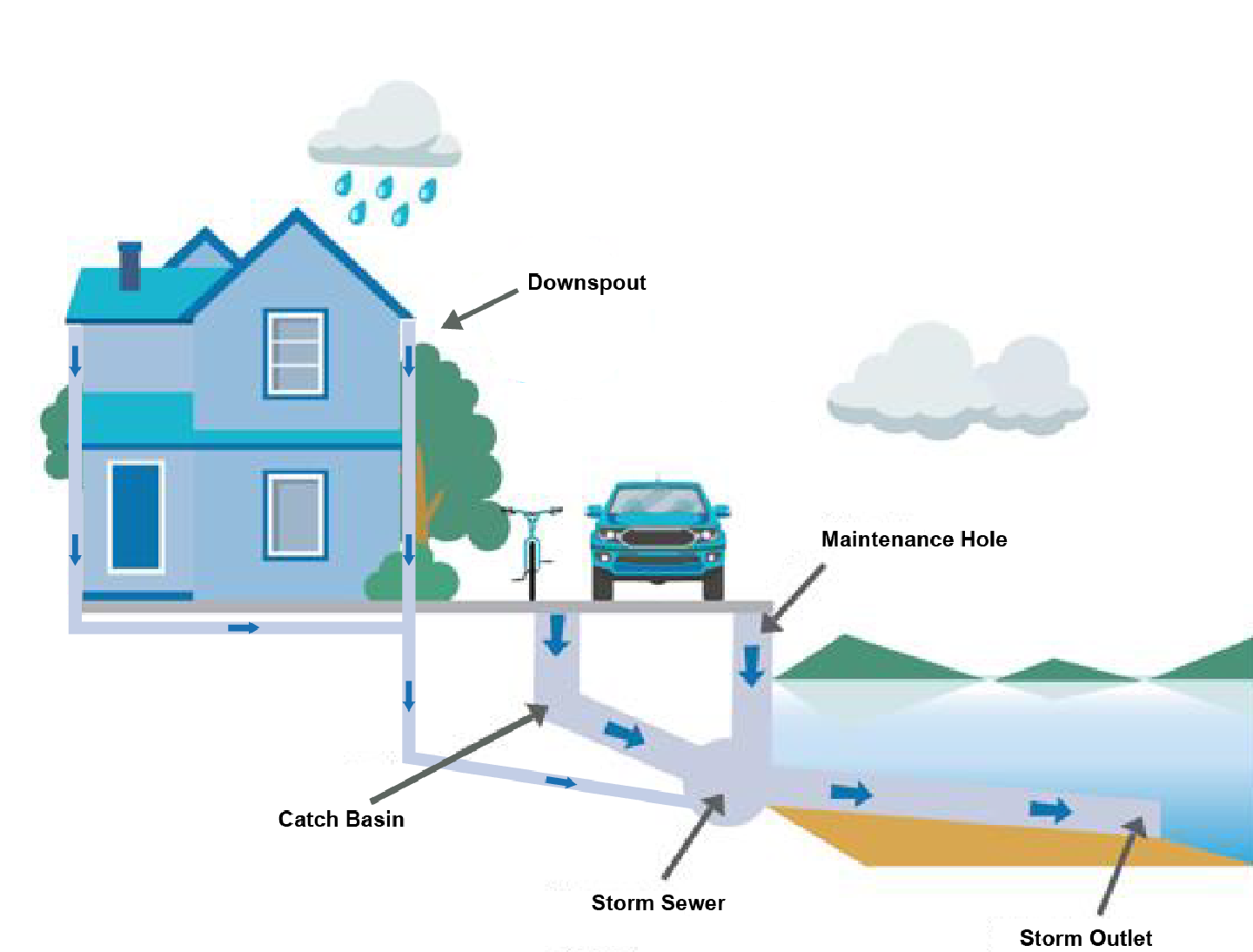 Underground stormwater infrastructure
Campbell River’s stormwater system is aging and most of it was designed many years ago before there were considerations for extreme weather events. Without regular investment, we risk:
- Flooding and property damage to homes, businesses and public spaces.
- Polluted waterways that harm fish, wildlife and the natural beauty we all enjoy.
- Higher emergency response costs when things go wrong.
Proactive and sustainable funding for our stormwater system helps protect public and private property, keeps our waters clean and builds resilience so our community can better handle extreme weather events.
Paying for Stormwater Services
How We Currently Pay
Property owners have always paid for stormwater services through a flat parcel tax, which can be found on property tax notices. Today, every property pays about $116 per year, regardless of its size or how much stormwater runoff it creates. A small home or café pays the same as a large store with a big parking lot, even though the larger property sends more water into the stormwater system.
Why We Are Reviewing This Approach
A flat fee is simple, but it may not be the fairest way to share costs. We’re exploring whether there’s a better approach – one that reflects a property’s impact on the stormwater system and helps keep the system strong as our infrastructure ages, our community evolves, and weather becomes more extreme.
How Other Cities Pay for Stormwater
Many cities take a fairer approach by charging stormwater fees based on a property’s estimated contribution to the city’s stormwater systems, such as sewers and waterways. This makes costs more proportional, encourages property owners to manage runoff and helps fund infrastructure that reduces flooding and pollution.
One option is a rate based on impervious area – hard surfaces like roofs, driveways and parking lots – because these surfaces create more runoff. Of the 2,000 stormwater fees in North America, over two-thirds use impervious area to determine a property’s stormwater fee.
About the Stormwater Utility Funding Study
The Stormwater Utility Funding Study is reviewing alternative funding models for stormwater services. A fee based on estimated impact also opens the door to incentives. Property owners who take steps to reduce the amount or improve the quality of runoff, such as installing rain gardens or oil-grit separators, could qualify for rebates or credits that lower their fee.
Get Involved
Please see our project timeline for key project updates.
Campbell River is reviewing how we fund stormwater management to keep our system strong, protect homes and waterways, and better ensure costs are shared fairly.
What is Stormwater and Why it Matters
Stormwater is the rain, melting snow and ice that washes off driveways, parking lots, roads, rooftops, and other surfaces. On natural surfaces, like grass or soil, water soaks into the ground like a sponge. But on impervious surfaces – those hard surfaces like parking lots and rooftops – rain and melted snow can’t absorb into the ground. Instead, it runs off these surfaces, picking up oil, chemicals, litter and other pollutants, and carries them through our storm sewers and out into nearby creeks, the Campbell River, and the Discovery Passage. Some, but not all, stormwater runoff is treated through street sweeping, catch basin cleaning and stormwater ponds.
Stormwater Management in Campbell River
Our stormwater system includes:
- Over 165 km of storm sewers
- 118 km of ditches
- 2,911 maintenance holes
- 4,313 catch basins
- 42,825 storm service connections
- 83 outfalls
- 25 stormwater management ponds
- 14 km of culverts
This infrastructure has a combined total value of over $230 million. Most of it is underground, so it’s easy to overlook, but it’s essential for preventing flooding and protecting our waterways.
Underground stormwater infrastructureCampbell River’s stormwater system is aging and most of it was designed many years ago before there were considerations for extreme weather events. Without regular investment, we risk:
- Flooding and property damage to homes, businesses and public spaces.
- Polluted waterways that harm fish, wildlife and the natural beauty we all enjoy.
- Higher emergency response costs when things go wrong.
Proactive and sustainable funding for our stormwater system helps protect public and private property, keeps our waters clean and builds resilience so our community can better handle extreme weather events.
Paying for Stormwater Services
How We Currently Pay
Property owners have always paid for stormwater services through a flat parcel tax, which can be found on property tax notices. Today, every property pays about $116 per year, regardless of its size or how much stormwater runoff it creates. A small home or café pays the same as a large store with a big parking lot, even though the larger property sends more water into the stormwater system.
Why We Are Reviewing This Approach
A flat fee is simple, but it may not be the fairest way to share costs. We’re exploring whether there’s a better approach – one that reflects a property’s impact on the stormwater system and helps keep the system strong as our infrastructure ages, our community evolves, and weather becomes more extreme.
How Other Cities Pay for Stormwater
Many cities take a fairer approach by charging stormwater fees based on a property’s estimated contribution to the city’s stormwater systems, such as sewers and waterways. This makes costs more proportional, encourages property owners to manage runoff and helps fund infrastructure that reduces flooding and pollution.
One option is a rate based on impervious area – hard surfaces like roofs, driveways and parking lots – because these surfaces create more runoff. Of the 2,000 stormwater fees in North America, over two-thirds use impervious area to determine a property’s stormwater fee.
About the Stormwater Utility Funding Study
The Stormwater Utility Funding Study is reviewing alternative funding models for stormwater services. A fee based on estimated impact also opens the door to incentives. Property owners who take steps to reduce the amount or improve the quality of runoff, such as installing rain gardens or oil-grit separators, could qualify for rebates or credits that lower their fee.
Get Involved
Please see our project timeline for key project updates.
Have a question?
-
Share How can a home owner reduce the hard surfaces when the contractor has put in concrete driveways and sidewalks.? I understand and have alternate surfaces for my extra driveway. Can’t we find other ways to distribute the runoff back into the ground? To ensure cleaner water why aren’t all new home having gutter screens installed. The amount of grit from asphalt tiles is a huge amount every year. on Facebook Share How can a home owner reduce the hard surfaces when the contractor has put in concrete driveways and sidewalks.? I understand and have alternate surfaces for my extra driveway. Can’t we find other ways to distribute the runoff back into the ground? To ensure cleaner water why aren’t all new home having gutter screens installed. The amount of grit from asphalt tiles is a huge amount every year. on Twitter Share How can a home owner reduce the hard surfaces when the contractor has put in concrete driveways and sidewalks.? I understand and have alternate surfaces for my extra driveway. Can’t we find other ways to distribute the runoff back into the ground? To ensure cleaner water why aren’t all new home having gutter screens installed. The amount of grit from asphalt tiles is a huge amount every year. on Linkedin Email How can a home owner reduce the hard surfaces when the contractor has put in concrete driveways and sidewalks.? I understand and have alternate surfaces for my extra driveway. Can’t we find other ways to distribute the runoff back into the ground? To ensure cleaner water why aren’t all new home having gutter screens installed. The amount of grit from asphalt tiles is a huge amount every year. link
How can a home owner reduce the hard surfaces when the contractor has put in concrete driveways and sidewalks.? I understand and have alternate surfaces for my extra driveway. Can’t we find other ways to distribute the runoff back into the ground? To ensure cleaner water why aren’t all new home having gutter screens installed. The amount of grit from asphalt tiles is a huge amount every year.
Ghues asked 3 months agoThanks for your question and your interest in our Stormwater Utility Funding Study. Creating rain gardens, using rain barrels, and planting trees and shrubs are excellent ways for a homeowner to affect the amount of stormwater runoff coming from their property. All new homes in Campbell River must adhere to the BC Building Code. While the installation of gutter screens is not mandated by the code, we encourage residents to install them whenever possible.
-
Share I benefit from the store parking lot being free of water. Any business will pass on its tax costs to me as a consumer in any event. I don't know how you'd come up with an equitable system based on usage. One place I lived had water meter charges that were reflected in sewer and storm sewer charges on the notion of water in equals water out. on Facebook Share I benefit from the store parking lot being free of water. Any business will pass on its tax costs to me as a consumer in any event. I don't know how you'd come up with an equitable system based on usage. One place I lived had water meter charges that were reflected in sewer and storm sewer charges on the notion of water in equals water out. on Twitter Share I benefit from the store parking lot being free of water. Any business will pass on its tax costs to me as a consumer in any event. I don't know how you'd come up with an equitable system based on usage. One place I lived had water meter charges that were reflected in sewer and storm sewer charges on the notion of water in equals water out. on Linkedin Email I benefit from the store parking lot being free of water. Any business will pass on its tax costs to me as a consumer in any event. I don't know how you'd come up with an equitable system based on usage. One place I lived had water meter charges that were reflected in sewer and storm sewer charges on the notion of water in equals water out. link
I benefit from the store parking lot being free of water. Any business will pass on its tax costs to me as a consumer in any event. I don't know how you'd come up with an equitable system based on usage. One place I lived had water meter charges that were reflected in sewer and storm sewer charges on the notion of water in equals water out.
X asked 3 months agoThanks for your question and your interest in our Stormwater Utility Funding Study. While most residential properties in Campbell River enjoy a flat annual water and wastewater fee, water and wastewater charges for non-residential and high density residential properties in Campbell River take the same approach of 'water in equals water out' that you mentioned. Many cities approach stormwater fees based on a property’s estimated contribution to the city’s stormwater systems. One way of doing so is based on impervious area – hard surfaces like roofs, driveways and parking lots – because these surfaces create more runoff. This City is reviewing this approach, and many others, to find the funding model that best fits Campbell River's needs.
-
Share You mention above that 2/3 of the 2000 cities/regions charging stormwater fees in North America, calculate the fee using impervious surface. I cannot verify when this article was posted on the Smart Prosperity Institute's website, but of the Canadian cities mentioned, only ONE uses impervious surface and only TWO use a runoff factor or coefficient. The ONE is Victoria BC where the stormwater levey was implemented in 2016. The costs to the school district, institutions, stratas and commercial properties increased significantly, particularly for strata properties where the charges went from being included on individual tax bills to the strata's operating budget. There was some consultation with commercial/institutional owners before implementation but many faced a new large charge midway through a budget year. 1. Have you consulted/informed the above class of property owner? 2. Have you investigated whether or not this is a cost-neutral utility - ie: paying for itself, something that was promised in Victoria? 3. Why are you including American cities in your research when the funding for their municipalities differs from a Canadian model? on Facebook Share You mention above that 2/3 of the 2000 cities/regions charging stormwater fees in North America, calculate the fee using impervious surface. I cannot verify when this article was posted on the Smart Prosperity Institute's website, but of the Canadian cities mentioned, only ONE uses impervious surface and only TWO use a runoff factor or coefficient. The ONE is Victoria BC where the stormwater levey was implemented in 2016. The costs to the school district, institutions, stratas and commercial properties increased significantly, particularly for strata properties where the charges went from being included on individual tax bills to the strata's operating budget. There was some consultation with commercial/institutional owners before implementation but many faced a new large charge midway through a budget year. 1. Have you consulted/informed the above class of property owner? 2. Have you investigated whether or not this is a cost-neutral utility - ie: paying for itself, something that was promised in Victoria? 3. Why are you including American cities in your research when the funding for their municipalities differs from a Canadian model? on Twitter Share You mention above that 2/3 of the 2000 cities/regions charging stormwater fees in North America, calculate the fee using impervious surface. I cannot verify when this article was posted on the Smart Prosperity Institute's website, but of the Canadian cities mentioned, only ONE uses impervious surface and only TWO use a runoff factor or coefficient. The ONE is Victoria BC where the stormwater levey was implemented in 2016. The costs to the school district, institutions, stratas and commercial properties increased significantly, particularly for strata properties where the charges went from being included on individual tax bills to the strata's operating budget. There was some consultation with commercial/institutional owners before implementation but many faced a new large charge midway through a budget year. 1. Have you consulted/informed the above class of property owner? 2. Have you investigated whether or not this is a cost-neutral utility - ie: paying for itself, something that was promised in Victoria? 3. Why are you including American cities in your research when the funding for their municipalities differs from a Canadian model? on Linkedin Email You mention above that 2/3 of the 2000 cities/regions charging stormwater fees in North America, calculate the fee using impervious surface. I cannot verify when this article was posted on the Smart Prosperity Institute's website, but of the Canadian cities mentioned, only ONE uses impervious surface and only TWO use a runoff factor or coefficient. The ONE is Victoria BC where the stormwater levey was implemented in 2016. The costs to the school district, institutions, stratas and commercial properties increased significantly, particularly for strata properties where the charges went from being included on individual tax bills to the strata's operating budget. There was some consultation with commercial/institutional owners before implementation but many faced a new large charge midway through a budget year. 1. Have you consulted/informed the above class of property owner? 2. Have you investigated whether or not this is a cost-neutral utility - ie: paying for itself, something that was promised in Victoria? 3. Why are you including American cities in your research when the funding for their municipalities differs from a Canadian model? link
You mention above that 2/3 of the 2000 cities/regions charging stormwater fees in North America, calculate the fee using impervious surface. I cannot verify when this article was posted on the Smart Prosperity Institute's website, but of the Canadian cities mentioned, only ONE uses impervious surface and only TWO use a runoff factor or coefficient. The ONE is Victoria BC where the stormwater levey was implemented in 2016. The costs to the school district, institutions, stratas and commercial properties increased significantly, particularly for strata properties where the charges went from being included on individual tax bills to the strata's operating budget. There was some consultation with commercial/institutional owners before implementation but many faced a new large charge midway through a budget year. 1. Have you consulted/informed the above class of property owner? 2. Have you investigated whether or not this is a cost-neutral utility - ie: paying for itself, something that was promised in Victoria? 3. Why are you including American cities in your research when the funding for their municipalities differs from a Canadian model?
Elaine Smith asked 3 months agoThanks for the questions and for engaging on the Stormwater Utility Funding Study project!
Most of the Canadian municipalities mentioned in the report on the Smart Prosperity Institute's website (Smart Prosperity Institute | For a stronger, cleaner economy) do in fact charge stormwater fees based on actual or estimated impervious area. It is just a question of terminology. For instance, fees based on ERU, SFRU, intensity, or runoff coefficient, and most tiered flat rates are based on actual, estimated or average impervious area.
A more detailed review with comparable municipalities has been done looking only at municipalities in British Columbia. We did however also look at overall stormwater funding models used by municipalities across North America since the United States has a longer history of developing and maintaining municipal stormwater fees, and wanted to benefit from their experience. Also, comparing statistics from 2,000 municipalities can be very informative.
We are currently sharing information with Campbell River residents and businesses. This is the start of the public consultation process. Recommendations will shared with Council and the public later in 2026.
-
Share How would this fee change impact older houses that are not connected to stormwater pipes? on Facebook Share How would this fee change impact older houses that are not connected to stormwater pipes? on Twitter Share How would this fee change impact older houses that are not connected to stormwater pipes? on Linkedin Email How would this fee change impact older houses that are not connected to stormwater pipes? link
How would this fee change impact older houses that are not connected to stormwater pipes?
Adam B asked 3 months agoCurrently, all properties pay the same stormwater fee, whether it’s an older home, a newer home, or a large commercial property. The City is exploring ways to make this fee more equitable for everyone. That means looking at fairness, administrative practicality, how other municipalities handle stormwater, and the overall impact on the community.
While the City is reviewing several options, most Canadian municipalities do not base residential stormwater fees on the age of a home or whether its downspouts are directly connected to the stormwater system. This is because making those distinctions requires significant ongoing effort to track, verify, and update that information across thousands of properties.
Single family detached homes make up 75% of the properties in Campbell River. The new user fee model attempts to balance equitable fees and its administrative complexity and costs.
-
Share If you make the roads higher in the middle the rainwater runs to the sides where the sewers are, so you the road is not a puddle and the risks of the cars aquaplanning is reduced. That's how the roads in Shetland Islands (UK) are done, where it rains more than here. Just an idea. on Facebook Share If you make the roads higher in the middle the rainwater runs to the sides where the sewers are, so you the road is not a puddle and the risks of the cars aquaplanning is reduced. That's how the roads in Shetland Islands (UK) are done, where it rains more than here. Just an idea. on Twitter Share If you make the roads higher in the middle the rainwater runs to the sides where the sewers are, so you the road is not a puddle and the risks of the cars aquaplanning is reduced. That's how the roads in Shetland Islands (UK) are done, where it rains more than here. Just an idea. on Linkedin Email If you make the roads higher in the middle the rainwater runs to the sides where the sewers are, so you the road is not a puddle and the risks of the cars aquaplanning is reduced. That's how the roads in Shetland Islands (UK) are done, where it rains more than here. Just an idea. link
If you make the roads higher in the middle the rainwater runs to the sides where the sewers are, so you the road is not a puddle and the risks of the cars aquaplanning is reduced. That's how the roads in Shetland Islands (UK) are done, where it rains more than here. Just an idea.
Chelo Cadavid asked about 1 year agoThank you for your feedback and interest in how the City helps manage stormwater!
The City's Works and Services Bylaw 3948, 2024 was updated in 2024 and speaks to the standards that roads in the city are to be built to. Those standards, amongst other things, take into consideration the proper conveyance of water along the road surface to help limit the pooling of water and will be implemented moving forward as roads are maintained and repaired, and new roads are constructed.
-
Share Why are so many storm drains blocked off in Jubilee Heights? on Facebook Share Why are so many storm drains blocked off in Jubilee Heights? on Twitter Share Why are so many storm drains blocked off in Jubilee Heights? on Linkedin Email Why are so many storm drains blocked off in Jubilee Heights? link
Why are so many storm drains blocked off in Jubilee Heights?
Lacey asked about 1 year agoSubdivision and building permits require contractors to prevent erosion and sediment from their works from entering the stormwater system. Work is currently taking place in Jubilee Heights, and the contractors have taken necessary measures to avoid this, including installing filters in nearby catch basins.
To report any concerns related to catch basins, please call 250.286.4033.
-
Share Could you raise the roads in the middle? In Shetland Islands the roads are slightly raised in the middle, the water rains to the sides and you won't see a puddle on the road. on Facebook Share Could you raise the roads in the middle? In Shetland Islands the roads are slightly raised in the middle, the water rains to the sides and you won't see a puddle on the road. on Twitter Share Could you raise the roads in the middle? In Shetland Islands the roads are slightly raised in the middle, the water rains to the sides and you won't see a puddle on the road. on Linkedin Email Could you raise the roads in the middle? In Shetland Islands the roads are slightly raised in the middle, the water rains to the sides and you won't see a puddle on the road. link
Could you raise the roads in the middle? In Shetland Islands the roads are slightly raised in the middle, the water rains to the sides and you won't see a puddle on the road.
Chelo Cadavid asked about 1 year agoThank you for reaching out. Your feedback has been shared with the project team for their consideration.
-
Share Will you consider incentivizing changing hard surface driveways, parking lots and laneways to permeable surfaces and require that in new construction? on Facebook Share Will you consider incentivizing changing hard surface driveways, parking lots and laneways to permeable surfaces and require that in new construction? on Twitter Share Will you consider incentivizing changing hard surface driveways, parking lots and laneways to permeable surfaces and require that in new construction? on Linkedin Email Will you consider incentivizing changing hard surface driveways, parking lots and laneways to permeable surfaces and require that in new construction? link
Will you consider incentivizing changing hard surface driveways, parking lots and laneways to permeable surfaces and require that in new construction?
Sue Moen asked over 1 year agoThanks for the question! The City is exploring multiple approaches to stormwater funding, including incentivizing the installation of permeable surfaces. The final recommendation, which will look to balance equity, effectiveness and costs, will be reviewed and considered by Council before implementation.
For new construction, the City enacted a new Works and Services Bylaw 3948 earlier this year that brings the City more in line with stormwater management best practices by better regulating the amount and quality of water that runs off from newly developed lands. While the City does not stipulate how new construction meets these standards, installing more permeable surfaces is one way it can be done.
To receive the latest updates on the current stormwater management study, please consider subscribing to the Stay Informed tab at Stormwater Utility Funding Study | Get Involved Campbell River.
-
Share When will we actually get any Stormwater drainage System in the Campbellton Area ? A lot of streets in the old core don't even have connection to such a system. on Facebook Share When will we actually get any Stormwater drainage System in the Campbellton Area ? A lot of streets in the old core don't even have connection to such a system. on Twitter Share When will we actually get any Stormwater drainage System in the Campbellton Area ? A lot of streets in the old core don't even have connection to such a system. on Linkedin Email When will we actually get any Stormwater drainage System in the Campbellton Area ? A lot of streets in the old core don't even have connection to such a system. link
When will we actually get any Stormwater drainage System in the Campbellton Area ? A lot of streets in the old core don't even have connection to such a system.
Leviani asked over 1 year agoThanks for the question! Establishing a user fee based model is the first step in creating equitable and sustainable stormwater utility funding. This will strengthening the City's ability to deliver enhanced stormwater services to those areas of the City that need it most. The study currently underway will help the City plan the future of stormwater management in Campbell River and information on this will be shared on the City website and Get Involved platform. To receive the latest updates please consider subscribing to the Stay Informed tab at Stormwater Utility Funding Study | Get Involved Campbell River. Please inform the City of any stormwater servicing issues you are experiencing by calling the Dogwood Operations Centre at 250.286.4033.
-
Share Can somebody clean my storm water 💧 pipe that's plugged close to the front of my house 🏠? Located in Georgia park.? on Facebook Share Can somebody clean my storm water 💧 pipe that's plugged close to the front of my house 🏠? Located in Georgia park.? on Twitter Share Can somebody clean my storm water 💧 pipe that's plugged close to the front of my house 🏠? Located in Georgia park.? on Linkedin Email Can somebody clean my storm water 💧 pipe that's plugged close to the front of my house 🏠? Located in Georgia park.? link
Can somebody clean my storm water 💧 pipe that's plugged close to the front of my house 🏠? Located in Georgia park.?
Amby asked over 1 year agoHi, there. To report any stormwater issues, please contact dogwood.centre@campbellriver.ca.
Who's Listening
-

Phone 250-286-4033 Email steve.roehr@campbellriver.ca
Lifecycle
-
Phase 1: Information Sharing
Stormwater Utility Funding Study has finished this stageSummer 2024
-
Phase 2: Public Education
Stormwater Utility Funding Study is currently at this stageWinter 2025/2026
-
Phase 3: Draft and Final Recommendations
this is an upcoming stage for Stormwater Utility Funding Study2026
FAQs
- What is impervious area?
- How will hard or impervious surfaces be measured?
- How is the City currently funding the stormwater system? Who is paying for this?
- Why should I pay for stormwater management when I don’t have a stormwater connection to a storm sewer?
- But what if I take measures on my property that reduce its impact on the stormwater system?
- Would a new stormwater fee work the same for residents and businesses?
Thank you for your contribution!
Help us reach out to more people in the community
Share this with family and friends